






NP04-KK360 | Multi-Channel Precision Liquid Feeding for Parallel Experiments
2026-07-24 15:39:51
In scientific research, fine chemical development, biopharmaceutical process development, and electrochemical testing, researchers often need to supply liquids to multiple experimental channels at the same time. Whether the liquid delivery is stable, repeatable, and easy to switch between different parameters can directly affect experimental efficiency and data consistency.
Founded in 2005, Kamoer is a reliable micro-pump manufacturer specializing in precision fluid transfer technologies. Its product portfolio covers peristaltic pumps, diaphragm liquid pumps, diaphragm air pumps, and customized fluid control modules, serving applications in life sciences, smart living, industrial automation, and laboratory equipment. With the mission of “Reliability empowers customers,” Kamoer provides stable, precise, and easy-to-integrate microfluidic transfer solutions for customers worldwide.
For multi-channel, low-flow, and long-duration experimental liquid feeding needs, the Kamoer NP04-KK360 intelligent peristaltic pump can serve as the core liquid delivery module in a multi-channel feeding system for parallel experiments, providing stable, controllable, and repeatable liquid transfer for multiple experimental channels.
Why parallel experiments need multi-channel liquid feeding
In traditional laboratory workflows, when multiple experiments need to run simultaneously, users often rely on several single-channel pumps or manual pipetting to deliver liquids to different channels.
This may be acceptable for simple tests, but when the number of experimental conditions increases, several problems quickly appear. Multiple pumps take up valuable bench space, wiring and tubing become complicated, and flow settings across channels are difficult to manage consistently. When experimental tasks change frequently, parameters need to be set repeatedly. Manual liquid handling can also be affected by operator habits, timing differences, and fatigue, resulting in lower consistency.
For applications such as condition screening, formulation optimization, electrochemical reaction testing, material synthesis, and biopharmaceutical R&D, researchers need a liquid feeding solution that supports independent multi-channel dosing, stable low-flow delivery, long-term operation, and fast parameter switching.
The role of NP04-KK360 in parallel experiments
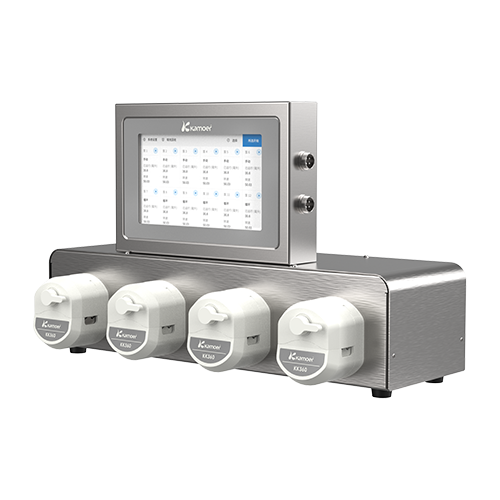
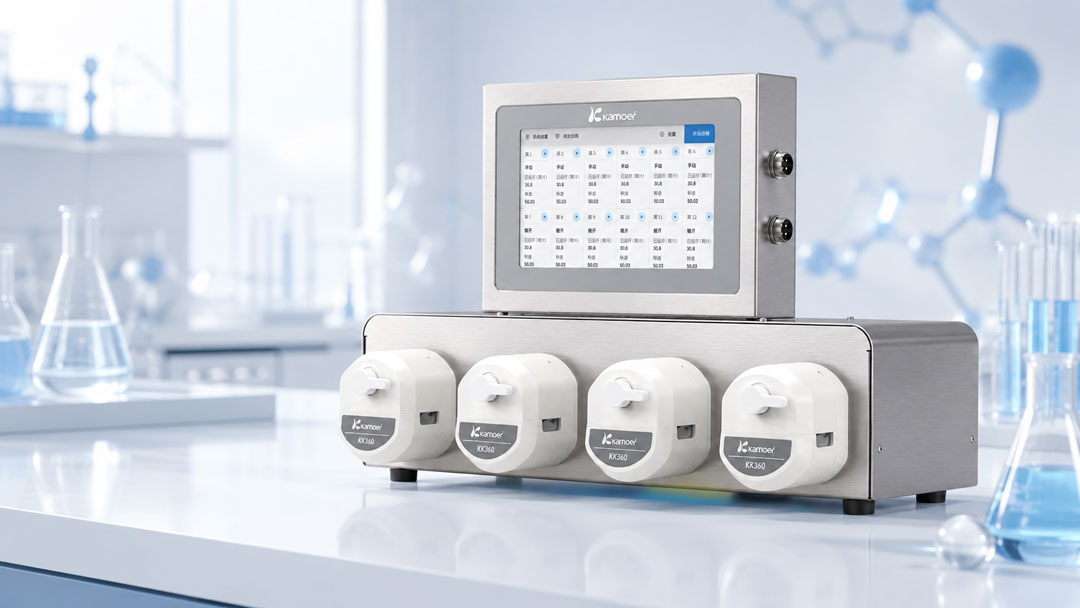
The NP04-KK360 adopts a multi-pump-head structure. One basic unit supports 4 independent liquid feeding channels. Each channel can be configured separately according to the experimental requirements, including flow rate, operation mode, and delivery parameters. It can also support synchronized multi-channel operation for parallel dosing, continuous feeding, circulation, or quantitative dispensing.
In real experimental setups, the NP04-KK360 can be used to deliver liquids to multiple reaction tubes, reactors, flow electrochemical cells, microreactors, reagent bottles, or sample containers. For parallel screening experiments, the 4 channels can deliver different reagents to 4 experimental units. In continuous flow experiments, it can be used for feeding main liquid, auxiliary liquid, buffer, or additives. In electrocatalysis experiments, it can help manage catholyte circulation, anolyte circulation, additive feeding, and product or waste collection.
For larger experimental platforms, the system can be stacked and expanded to support more channels, meeting the needs of both small-scale testing and multi-channel parallel experimental platforms.
Solving three key pain points in laboratory liquid feeding
1. High precision requirements and flow fluctuation concerns
The value of parallel experiments lies in comparison. Apart from the variables intentionally designed by the researcher, the liquid delivery conditions across different channels should remain as stable and consistent as possible. If the flow rate fluctuates significantly or pulsation becomes obvious at low flow rates, it may affect reaction rate, concentration stability, and experimental repeatability.
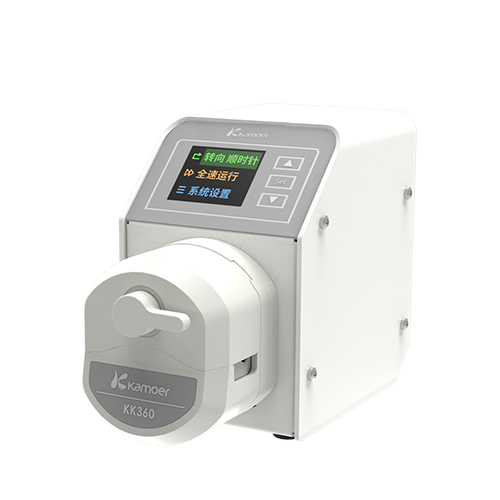
The NP04-KK360 is equipped with a closed-loop stepper motor, enabling stable speed control. Combined with a three-roller staggered design, it helps reduce pulsation during low-flow liquid delivery and provides smoother fluid output. This supports better liquid transfer consistency in parallel experiments.
For tasks requiring repeated verification, users can also improve channel-to-channel and batch-to-batch repeatability through parameter setting and calibration.
2. Limited laboratory bench space
Laboratory benches, fume hoods, electrochemical test platforms, and small-scale development systems often have limited space. Using multiple single-channel pumps not only occupies more space but also increases the complexity of power supply, wiring, control, and tubing management.
The NP04-KK360 integrates 4 pump heads into a compact structure, enabling multi-channel liquid delivery within a limited space. Compared with multiple separate single-channel pumps, the integrated design keeps the system more organized, makes tubing layout clearer, and simplifies maintenance and experiment management.
When the experimental scale increases, users do not need to rebuild the entire fluid system. The modular stacking design allows flexible expansion to meet higher channel requirements.
3. Frequent task switching and repeated parameter setting
In research and development environments, experimental workflows are rarely fixed. Different samples, concentrations, reaction times, and dosing volumes may all require different liquid delivery settings. Repeating these settings manually for every experiment is inefficient and can introduce errors.
The NP04-KK360 is equipped with a 7-inch touchscreen and an intuitive graphical interface, allowing users to quickly set flow rate, operation mode, and channel parameters. Commonly used experimental methods can be saved as programs and recalled quickly, reducing repetitive operation.
This is especially useful for condition screening, formulation optimization, small-scale validation, and long-duration experiments. Researchers can create different operating programs for different experimental methods and switch between tasks more efficiently.
Typical application scenarios
The NP04-KK360 can be used in a wide range of parallel experiment feeding applications.
In scientific research, it can be used for reagent dispensing, buffer feeding, sample pretreatment, and synchronized liquid addition to multiple reaction systems.
In fine chemical R&D, it is suitable for catalyst screening, additive feeding, auxiliary liquid dosing, and low-volume continuous transfer of functional liquids such as dyes or specialty chemical solutions.
In biopharmaceutical R&D, it can support stable dispensing and feeding of culture media, buffers, enzyme solutions, protein solutions, and diagnostic reagents.
In electrochemistry and electrocatalysis, it can be used for catholyte circulation, anolyte circulation, additive feeding, and product or waste collection in flow electrochemical cells, helping researchers build a more stable and organized multi-path liquid feeding system.
A liquid feeding platform for experimental efficiency and data consistency
The value of parallel experiments is not only about running more tests at the same time. More importantly, it is about ensuring controllable, stable, and repeatable liquid delivery conditions across multiple experimental channels.
As a reliable micro-pump manufacturer, Kamoer integrates its long-term experience in micro-pump R&D, manufacturing, and application engineering into the design of the NP04-KK360. With 4 independent feeding channels, closed-loop stepper motor control, low-pulsation three-roller pump head structure, compact modular design, and 7-inch touchscreen program management, the NP04-KK360 helps users reduce the complexity of multi-pump system setup while improving experimental efficiency and data consistency.
For scientific research, fine chemical development, biopharmaceutical R&D, and electrocatalysis studies, the NP04-KK360 is more than a liquid transfer device. It can serve as a core multi-channel liquid feeding module for parallel experimental systems, providing stable support for low-flow, multi-channel, and highly repeatable experimental tasks.
Related Products